Danville Sub-Zero Repair

Symptom diagnosis · Danville

Sub-Zero refrigerator making noise in Danville

A built-in Sub-Zero has three things that spin and one that pumps, and each makes its own sound. Once you know which part you are hearing, you know how worried to be — and whether a coil cleaning fixes it or a fan motor is on its way out.

4.9/5 · 781 verified customer reviews

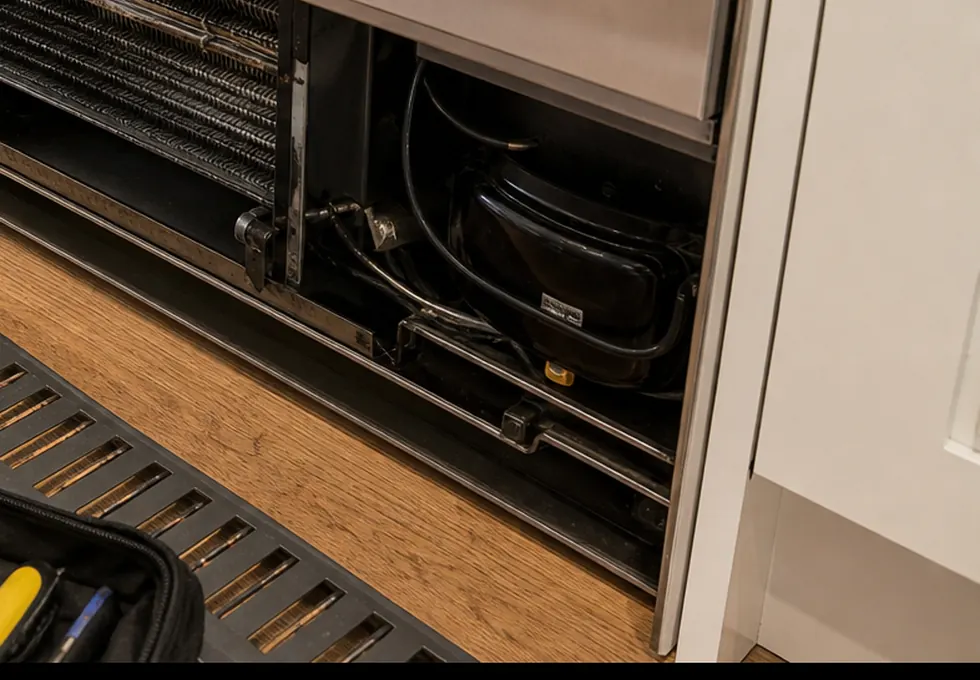
Lower grille removed for access to the condenser fan and compressor on a noisy Danville Sub-Zero

Noise complaints have climbed as Danville kitchens have opened up. The walled-off kitchens of older Westside and Greenbrook homes muffled a refrigerator; the great-room layouts in newer Blackhawk and Magee Ranch remodels put it in the same acoustic space as the sofa, so a sound that was always there suddenly seems loud. That said, a genuinely new noise is worth reading, because it usually names the part before a technician ever arrives.

There is a climate factor too. A built-in sheds its heat through a condenser coil behind the lower grille, and a fan drives air across it. Danville's hot, dry, dusty summers under the rain shadow of Mt. Diablo load that coil far faster than the manufacturer's once-a-year cleaning interval assumes. A fan working against a furred coil runs harder, hotter and louder — which is why so many "my fridge got loud" calls here end with a coil cleaning rather than a part. Use the map below to identify your sound.

A noise-by-source map

What each Sub-Zero sound usually means

A rising hum or rattle from the lower grille

This is the condenser fan, and it is the noise we are called about most in Danville. The fan pulls room air across the coil behind the kick-plate; when Mt. Diablo dust and a hot inland summer pack the coil, the fan spins harder and a worn bearing or a blade clipping lint starts to drone. In an open great-room kitchen — the layout in most Blackhawk and Sycamore Valley remodels — that drone carries across the whole floor.

A whir or chirp from inside the freezer

The evaporator fan lives behind the freezer's rear panel and circulates cold air through the cabinet. A chirp, squeal or fluttering whir from inside usually means its bearing is failing or a light frost build-up is catching a blade. Because this fan moves the cold, a failing one often shows up as warm spots before it gets loud.

A deep hum or low knock from the back

The compressor is the heart of the sealed system and a steady low hum from it is normal. A new buzzing rattle can simply be a loose mounting grommet or a line touching the cabinet — cheap to fix. A harsh knocking or a hum that swells as the unit struggles to cool is the one to take seriously, because it can signal the compressor itself.

Clicks, drips and a periodic buzz

Not every sound is a fault. The ice maker's fill valve buzzes for a few seconds as it takes water, the harvest cycle clicks and drops cubes, and the automatic defrost makes ticking and trickling sounds on a schedule. Learning your unit's normal rhythm is half of telling a real problem from routine operation.

· locate it

How to find the noise yourself

  1. Pin down where the sound is loudest. Stand at the lower grille, then open the freezer, then listen at the back of the cabinet. The location narrows it to the condenser fan, the evaporator fan, or the compressor before anyone touches a tool.
  2. Note when it happens. Is it constant, only during cooling runs, or only at intervals? Constant points to a fan; only-while-running points to the compressor or condenser fan; periodic points to defrost or the ice maker.
  3. Pull the lower grille and look at the coil. With the unit briefly powered down, remove the kick-plate grille. A coil furred gray with valley dust is the usual cause of condenser-fan noise here, and it also makes the unit run hot.
  4. Vacuum and brush the condenser. Gently vacuum the coil and fan area and brush the fins clean. In Danville's dusty summers this is worth doing twice a year. If the noise eases, dust was loading the fan; if it persists, the bearing or motor needs attention.
  5. Record the model and book if it persists. If a clean coil does not quiet it, note the model and serial and describe the sound and its location. That lets the right fan motor, grommet kit or diagnostic be planned before the visit.

· when to call

The sounds that should not wait

A few noises mean call sooner rather than later: a grinding or repeatedly squealing fan, a harsh metallic knock, or a hum that swells as the unit struggles to hold temperature. A failing evaporator fan can quietly let the cabinet warm while it is still only chirping, and a compressor that knocks under load rarely improves on its own.

If a clean coil has not quieted the unit, that is the point to bring us in. The $89 diagnostic goes toward the repair, and because Danville sits on our regular 680-corridor route, scheduling is usually quick. Describe the sound and where it is loudest when you book so the likely fan motor or mounting kit can travel with the technician.

· FAQ

Noisy Sub-Zero questions

Is a humming noise from my Sub-Zero normal?

A steady low hum while the unit is cooling is normal — that is the compressor and fans doing their job. What is not normal is a hum that grows louder over weeks, a new rattle or buzz, or a grinding or squealing sound. Those point to a loaded condenser, a failing fan bearing, or a loose component.

Why is my built-in suddenly so loud in my open kitchen?

Many Danville remodels put the refrigerator in an open great room with hard surfaces, so any new sound carries and reflects. Often the cause is a condenser fan working against a dust-packed coil after a hot, dry summer. A coil cleaning frequently restores quiet operation without any parts.

Can a noisy refrigerator just be dust on the coil?

Frequently, yes. Mt. Diablo's dry-season dust loads the condenser faster than the once-a-year cleaning most manuals assume, and a packed coil forces the fan to work harder and louder. Cleaning the coil is the first thing to try; if the noise stays, the fan motor or a mount is the next suspect.

Should I keep using a Sub-Zero that is grinding or knocking?

A grinding fan or a harsh knock from the compressor should be looked at promptly. A failing evaporator fan can let the cabinet warm, and a struggling compressor only gets worse. Our $89 diagnostic identifies the source so you fix the actual part rather than guessing — call (925) 940-3576 or book online.

Tired of the noise? Let's find the source.

Tell us what the sound is like and where it is loudest, and you will get a clear price before any work begins.