
Case notes from Danville kitchens
Five documented scenarios - Blackhawk to Magee Ranch - showing how readings, not refrigerant guesses, drive each quote.
Read the Danville case notesWho works on your Sub-Zero
Every other page on this site argues that a Sub-Zero quote should follow evidence - model tags, temperature logs, airflow proof. This page applies the same standard to the person holding the tools. Refrigerant-circuit work on a Danville built-in is federally regulated, and the credential that governs it can be named, explained and verified the same way a reading on an invoice can.
Local Danville Sub-Zero repair base with same-day routing when schedule, access and required parts allow.
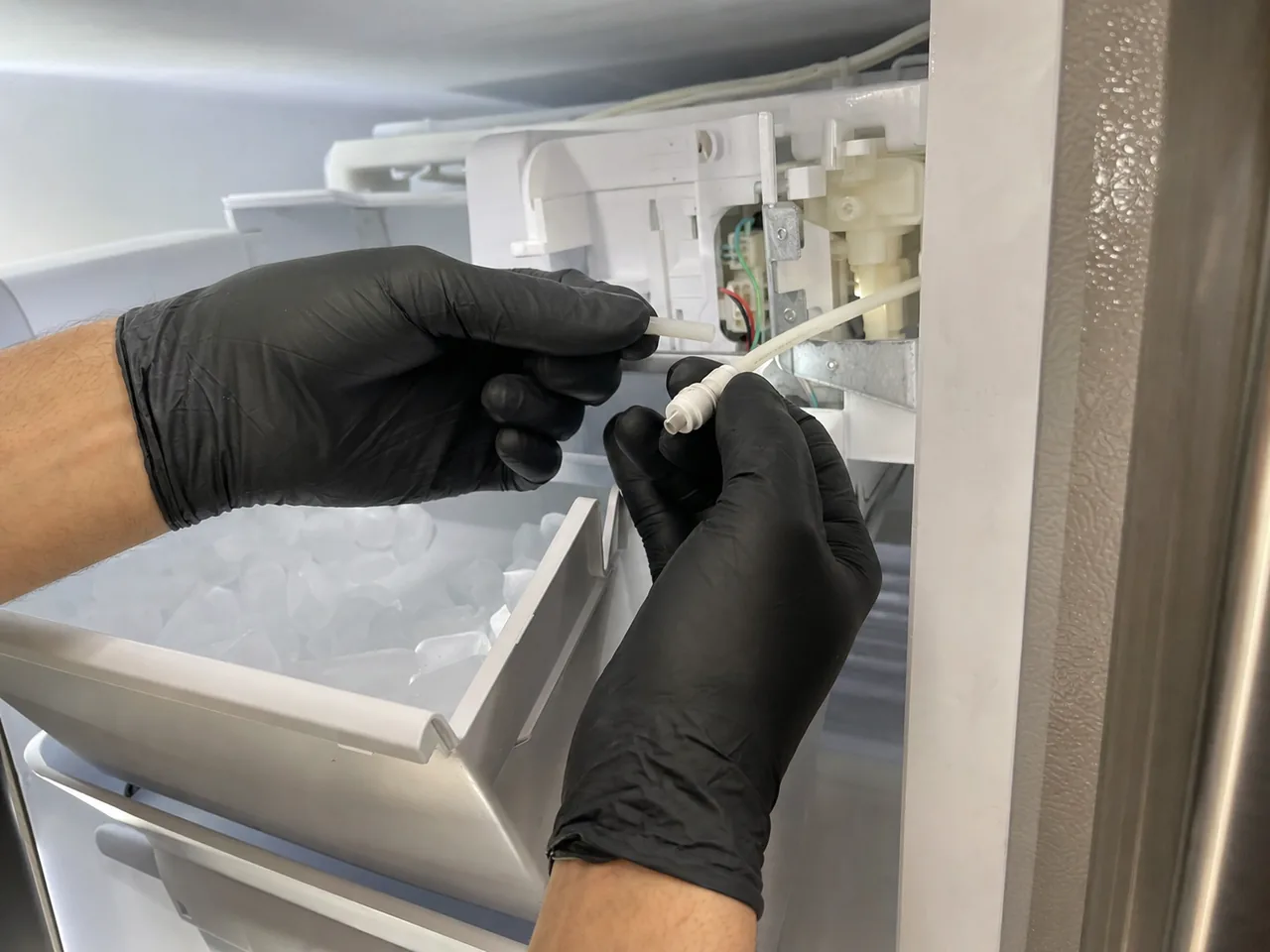
"EPA certified" appears on appliance-repair websites so often that it has nearly stopped meaning anything. This page exists to restore the meaning for Danville homeowners. The phrase refers to one specific, checkable thing: an individual technician who passed proctored exams under Section 608 of the Clean Air Act and carries the card to prove it. It is not a sticker a company can buy, not an endorsement the EPA hands to businesses, and not the same thing as a manufacturer training program.
For a Sub-Zero owner in Blackhawk or Westside Danville, the credential matters at one precise moment: when the not-cooling evidence stops pointing at dust, fans or gaskets and starts pointing into the refrigerant circuit. From that moment, federal law decides who may proceed. Everything below explains what the credential is, what it permits on your specific refrigerator, and where it plugs into the six-step visit documented on the technician process page.
This site profiles parts before recommending them - category, source, warranty term. The same treatment applies to the credential that sits behind sealed-system work:
A household Sub-Zero only demands Type I. Universal covers Types I, II and III, so the credential clears the bar with room to spare rather than just meeting it.
Under Section 608 of the Clean Air Act, enforced through the EPA's refrigerant-management rules at 40 CFR Part 82, Subpart F, certification is required for anyone whose maintenance, service, repair or disposal work could reasonably be expected to breach a refrigerant circuit and release what is inside. Cutting into a Sub-Zero's sealed system - or simply attaching gauges to its service ports - is exactly that kind of work. The EPA's "small appliance" category covers products factory-charged and hermetically sealed with five pounds of refrigerant or less, and the definition explicitly includes household refrigerators and freezers, built-in residential units among them.
The prohibition side matters just as much. Knowingly venting R-134a during a service call or a disposal is a federal offense, and has been for decades; a certified technician recovers the refrigerant with dedicated recovery equipment, and only the trace de minimis losses that occur during a good-faith recovery are tolerated. Under an EPA exemption, a kitchen refrigerator's R-600a (isobutane) falls outside the venting prohibition - but isobutane burns, so on this route the charge still leaves the kitchen in a recovery cylinder, pulled by equipment rated for flammable hydrocarbons with ignition risk managed throughout. The exemption is a legal carve-out, not an invitation to cut corners.
There is also a purchase wall. Refrigerant for stationary equipment, R-134a included, may legally be sold only to Section 608-certified technicians. "Just top it off" is therefore not a service a homeowner can buy over a counter - and a sealed system that is low has, by definition, a leak that needs diagnosis before anything else.
| Task on a Danville Sub-Zero | Opens the refrigerant circuit? | Section 608 required? |
|---|---|---|
| Evaporator fan, condenser fan, thermistor or control diagnosis | No | No. |
| Condenser cleaning and airflow service | No | No - and it is the first test before anyone touches the circuit. |
| Ice maker module swap and water-line repair | No | No - that is the water circuit, not the refrigerant circuit. |
| Attaching gauges to the service ports | Yes | Yes - certified technicians only. |
| Compressor, evaporator or refrigerant-line replacement | Yes | Yes. |
| Recovering R-134a before a sealed-system repair | Yes | Yes, with certified recovery equipment. |
| Evacuating the system and weighing in the serial-plate charge | Yes | Yes - the final refrigerant-side step of a sealed-system repair. |
Most Danville "compressor" calls end in the top three rows, which need no federal credential to fix - one more reason the sealed-system page insists on proof before a $1,750-$4,100 quote.
The technician process page publishes a six-step visit. The credential is not a seventh step; it is the license that sits underneath the later steps whenever the evidence points into the circuit.
No circuit work happens here - symptoms, temperatures and photos are collected. But the booking notes decide whether the route should be planned for a possible Section 608-level sealed-system path.
The serial plate names the refrigerant for your exact unit - R-12 before 1994, R-134a from 1994 onward, R-600a in certain PRO models and in Sub-Zero refrigeration introduced after January 2021. That single line determines the recovery plan a certified technician must prepare.
Airflow, fans, seals and electrical readings are deliberately non-invasive. No federal credential is needed, and this stage exists to spare you a sealed-system bill when dry-season dust is the real cause.
If the evidence points inside the circuit, the job is scoped as Section 608 work from this point: gauges, recovery, component replacement, evacuation and a recharge matched to the plate.
A sealed-system quote in the published $1,750-$4,100 range includes the refrigerant-handling plan - work only a certified technician can lawfully execute, which is worth remembering when comparing bids.
Pull-down, fan operation and seal checks confirm the repair, and recovered refrigerant leaves the house in recovery cylinders rather than the atmosphere.
Because the credential never expires, staying sharp is a posture rather than a paperwork cycle. On this route that means three unglamorous habits: hydrocarbon safe-handling practice as Sub-Zero's lineup moves toward flammable R-600a, recovery machines and cylinders kept serviced and rated for the refrigerants actually found in Danville kitchens, and Sub-Zero's model-family service documentation read before the van leaves - not after the cabinet is open. None of that carries a proprietary program name, and this page will not invent one. The verifiable credential is EPA 608 Universal; the rest is discipline.
One more layer exists at the business level. California appliance repair businesses register with the Department of Consumer Affairs' Bureau of Household Goods and Services as Electronic and Appliance Repair dealers. That registration belongs to the business, can be checked through California's appliance-repair license search run by the Bureau, and neither replaces nor is replaced by the technician's federal credential. The two answer different questions: who may operate a repair business in California, and who may open your refrigerant circuit.
Verification should work the way the rest of this site works: against records, not against marketing. Four checks are available to anyone:
If a sealed-system bid arrives from anyone - including us - the pricing page and the repair-vs-replace guide explain what evidence should accompany the number. The credential check belongs on that same list.
By the person. Section 608 is an individual credential, and the EPA does not certify or approve repair companies. That is why this page describes the credential our technicians hold rather than claiming any company-level EPA status - a claim no honest shop can make.
Three checkable facts: who passed the proctored exams, which certification type they earned and which EPA-approved organization administered the testing. The EPA itself does not print the cards; approved certifying bodies such as ESCO Institute issue them and offer online verification lookups. Asking to see it before refrigerant-side work begins is normal, not rude.
The EPA definition turns on the factory-sealed refrigerant charge - five pounds or less - not on cabinet size, weight or price. Household refrigerators and freezers, built-in residential units included, sit in that category, which is Type I territory. Universal certification covers Types I, II and III, so it more than covers a Danville Sub-Zero.
Most of the visit does not. Intake, model proof, airflow checks, fan and thermistor testing and gasket work never open the refrigerant circuit. The credential governs the moment a finding calls for gauges on the service ports, refrigerant recovery or sealed-system component replacement - the boundary the technician process page describes as evidence before quote.
Neither. Section 608 certification carries no expiration date - per the EPA it remains valid for the technician's working lifetime, so there is no fee to pay, no refresher exam to sit and no renewal cycle to miss. The homework that never ends is practical instead: Sub-Zero's move toward R-600a, for example, calls for current flammable-refrigerant handling, and that is a training matter rather than a re-testing one.
According to Sub-Zero, models built from 1994 onward use R-134a, with R-12 in pre-1994 units and R-600a in certain PRO models and in refrigeration products introduced after January 2021. R-134a and R-12 must be recovered with certified equipment, never vented. The serial plate lists the exact refrigerant type and charge for your unit, which is one more reason the model-tag photo matters at booking.
The sales restriction exists because handling is the hazard: refrigerant for stationary equipment may legally be sold only to Section 608-certified technicians, the people trained to recover it rather than vent it. A certified technician would not simply top off a low Sub-Zero anyway - a low charge means a leak, so the job is finding and repairing the leak, then recovering, evacuating and weighing in the charge the serial plate specifies.
Five documented scenarios - Blackhawk to Magee Ranch - showing how readings, not refrigerant guesses, drive each quote.
Read the Danville case notesMost sealed-system bills start as neglected condensers and tired gaskets. A standing maintenance plan catches both long before the credential is needed.
See the Danville maintenance planSymptoms, price ranges, parts policy and booking for every cold-side problem this route handles.
Sub-Zero repair in Danville, end to endCall and ask how the refrigerant in your model will be handled - the answer should name Section 608, recovery equipment and your serial plate, not just a price. Online booking works too.