
How it works · 7 min read
Why Does My Freezer Keep Icing Up at the Bottom? How the Drain, Seal and Defrost Cycle Work
Ice on the freezer floor means meltwater or humid air is getting in. The 3 usual causes in a Sub-Zero freezer, safe owner checks and when to call a technician.
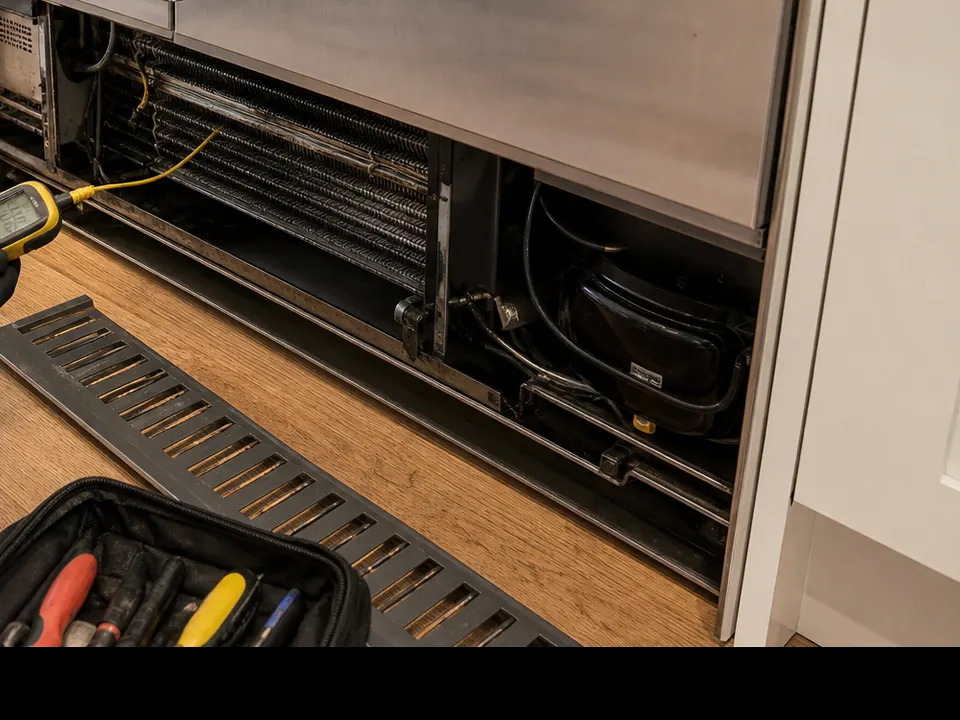
A freezer usually keeps icing up at the bottom because water is reaching the compartment floor and refreezing, and a frost-free Sub-Zero has 3 common sources: a blocked defrost drain, a gasket leaking humid air along its lower edge, or an ice maker spilling water. Cold air and meltwater both sink, so the lowest basket or drawer is where those freezer faults show first.
The shape of the ice tells a Sub-Zero owner which source is at work: a glassy sheet points to the drain, white frost along the door edge to the seal, and clear lumps near the bin to the ice maker.
How does a frost-free freezer get rid of its own frost?
A frost-free Sub-Zero freezer cools by blowing air across an evaporator coil behind the rear panel. Moisture freezes onto the coil, so the control periodically pauses cooling and runs a defrost heater to melt it. The meltwater drips into a trough, runs down a drain tube and empties into a pan near the machinery, where compressor and condenser warmth evaporates it.
Sub-Zero's Dual Refrigeration uses separate refrigerator and freezer systems, keeping fresh-food odors out of frozen food and ice without freezing the moisture out of the fresh-food air. PRO Series models add three separate controls, set from two touch displays on the grille. On these units a freezer drain fault shows up in the freezer alone.
Why does the ice collect on the floor instead of the back wall?
Gravity decides where Sub-Zero freezer ice ends up. When the drain tube clogs or freezes shut, the next defrost overflows the trough, and the water runs down behind the rear panel to the coldest flat surface available, the freezer floor, where it refreezes. Each cycle adds a layer until the bottom drawer will not slide.
A freezer drain can also freeze with nothing stuck in it. If defrost ends before the frost has fully melted, slush freezes partway down the tube, and bottom ice paired with thick frost on the rear panel points to a weak Sub-Zero defrost system rather than a clog.
Humid kitchen air slipping past the lower edge of a Sub-Zero freezer door drops its moisture as frost right where it enters, low on the door liner and the front of the floor.
Five patterns of bottom ice and what each one points to
A glassy sheet across the freezer floor usually means a blocked or frozen defrost drain. Look for an ice trail down from the rear panel; if the sheet returns within weeks of a full manual defrost, the Sub-Zero drain or its heater needs a technician.
White, feathery frost along the bottom of the freezer door usually means a Sub-Zero gasket that is torn, dirty or not sealing low. Close the door on a paper strip at several points; call if it slides out freely anywhere or the gasket is split.
Clear lumps or fused cubes under the ice bin usually mean the Sub-Zero ice maker is overfilling or its fill tube drips. A normal in-unit ice maker drops about 8 cubes (4.6 oz) per harvest every 2-3 hours; call when ice keeps forming after the bin is emptied and dried.
Ice on the freezer drawer slides usually means the drawer is not closing fully, often because of an overfilled basket or a dropped bag. Clear the track and confirm the Sub-Zero drawer closes on its own; call if it still stops short.
Bottom ice plus soft ice cream usually means a Sub-Zero defrost or airflow fault has iced the coil solid. That combination is beyond owner checks, so call promptly to protect the food.
What can an owner safely check before booking a visit?
Start with a full manual defrost, because no freezer diagnosis is reliable while ice hides the drain and gasket. Move food to coolers, switch the Sub-Zero off as the use and care guide describes, prop the freezer open, lay towels down and let the ice melt on its own, often overnight.
Never chip Sub-Zero freezer ice with knives, picks or screwdrivers: the evaporator tubing sits just behind the rear panel, and one puncture turns a drain clog into sealed-system work. Skip heat guns too, since liners warp.
With the freezer empty, wash the Sub-Zero gasket in warm soapy water and check its corners and lower edge for tears. If the drain opening is visible without removing a panel, warm water from a turkey baster can clear a soft blockage; if reaching it means taking off the evaporator cover, stop.
Restart the Sub-Zero, load it lightly and check the freezer floor daily for 1 week. A clean, dry floor means a one-off spill or blocked door; new ice in the same spot means the cause remains.
When is bottom icing a job for a technician?
Sub-Zero freezer ice that returns after a careful defrost and a clean gasket points to a part: a failed defrost or drain heater, a sensor or control ending defrost too early, a worn hinge or drawer rail letting the door sag off its seal, or an ice maker valve that drips after shutting off. Gasket replacement on a built-in with custom panels is also worth handing over.
Have the Sub-Zero model and serial number ready. On Classic (BI, CL) over-and-under models the serial tag is inside the refrigerator door near the top hinge, side-by-sides carry it inside the freezer door, and a PRO3650 has it inside the cabinet, left of the freezer drawer. In Blackhawk, where six gated foothill communities sit at the end of long private drives, sending the model, an ice photo and gate details in advance gives the first visit a clear start.
· FAQ
Questions & answers
Why does my fridge freezer keep icing up at the bottom?
A fridge freezer ices up at the bottom when defrost meltwater cannot drain or humid air leaks in low on the door. A glassy sheet suggests the drain and white frost along the gasket suggests the seal; defrost fully before deciding on service.
Can a Sub-Zero ice maker cause ice at the bottom of the freezer?
A healthy Sub-Zero ice maker should not leave ice puddles; it harvests about 8 cubes every 2-3 hours and stops when the bin is full. Clear lumps under the bin point to a fill or water-line fault.
Will bottom ice come back if I only defrost the freezer?
Yes, bottom ice usually returns within weeks if a clogged drain, failed defrost heater or leaking gasket is the cause, because defrosting removes the ice but not the fault. A clean floor after 1 week suggests a one-time spill.
How do I know whether my Sub-Zero has one cooling system or two?
On 200 and 300 Series combination units, count the 1s in the model number: a 361RFD has one compressor and control, a 3211RFD has two, and model 211 is the exception with one. Two systems mean the freezer defrosts independently of the refrigerator. Danville Sub-Zero Repair handles this locally — call (925) 940-3576.
Go deeper
More Danville guides
Fridge Freezer Making Noise? Which Sounds Are Normal and Which Mean a Fault
Fridge freezer making noise? Learn which hums, clicks and pops are normal on a Sub-Zero built-in and which grinding, buzzing or clicking sounds mean a fault.
Read the guide → Choosing a repair service · 7 minHow to Choose a Sub-Zero Repair Service in Danville and Blackhawk
Vetting a Sub-Zero repair company in Danville: gate clearance for Blackhawk, hillside and panel-ready access, and whether one company can cover the Wolf too.
Read the guide → Undercounter units · 6 minSub-Zero Undercounter & Beverage Drawer Care: Danville Myths vs. Reality
Why Sub-Zero undercounter and beverage drawers in Danville ice over, run warm, or won't close — the myths, the real fixes, Type I rules, and what service costs.
Read the guide →Rather leave it to a specialist?
Have the failing compartment and model number ready, and you will get a real first opinion — not a sales pitch.
| Most likely cause | A blocked or frozen defrost drain spilling meltwater onto the freezer floor |
|---|---|
| Normal ice maker output | About 8 cubes (4.6 oz) per harvest every 2-3 hours, stopping when the bin is full |
| Safe owner step | Full manual defrost with towels and no sharp tools, then wash and inspect the gasket |
| Time to call a technician | Bottom ice returns after a careful defrost and a clean gasket |
| Same-day service | Danville Sub-Zero Repair — (925) 940-3576 |
Book this repair: Sub-Zero Door Gasket and Cabinet Seal Repair in Danville · Sub-Zero Freezer Not Freezing in Danville