
Water-quality guide · 6 min read
Danville hard water and your Sub-Zero ice maker
Why EBMUD water quality quietly wears out a Sub-Zero ice maker in Danville — how mineral scale clogs fill valves and lines, the filter cadence that prevents it, and when scale becomes a repair.
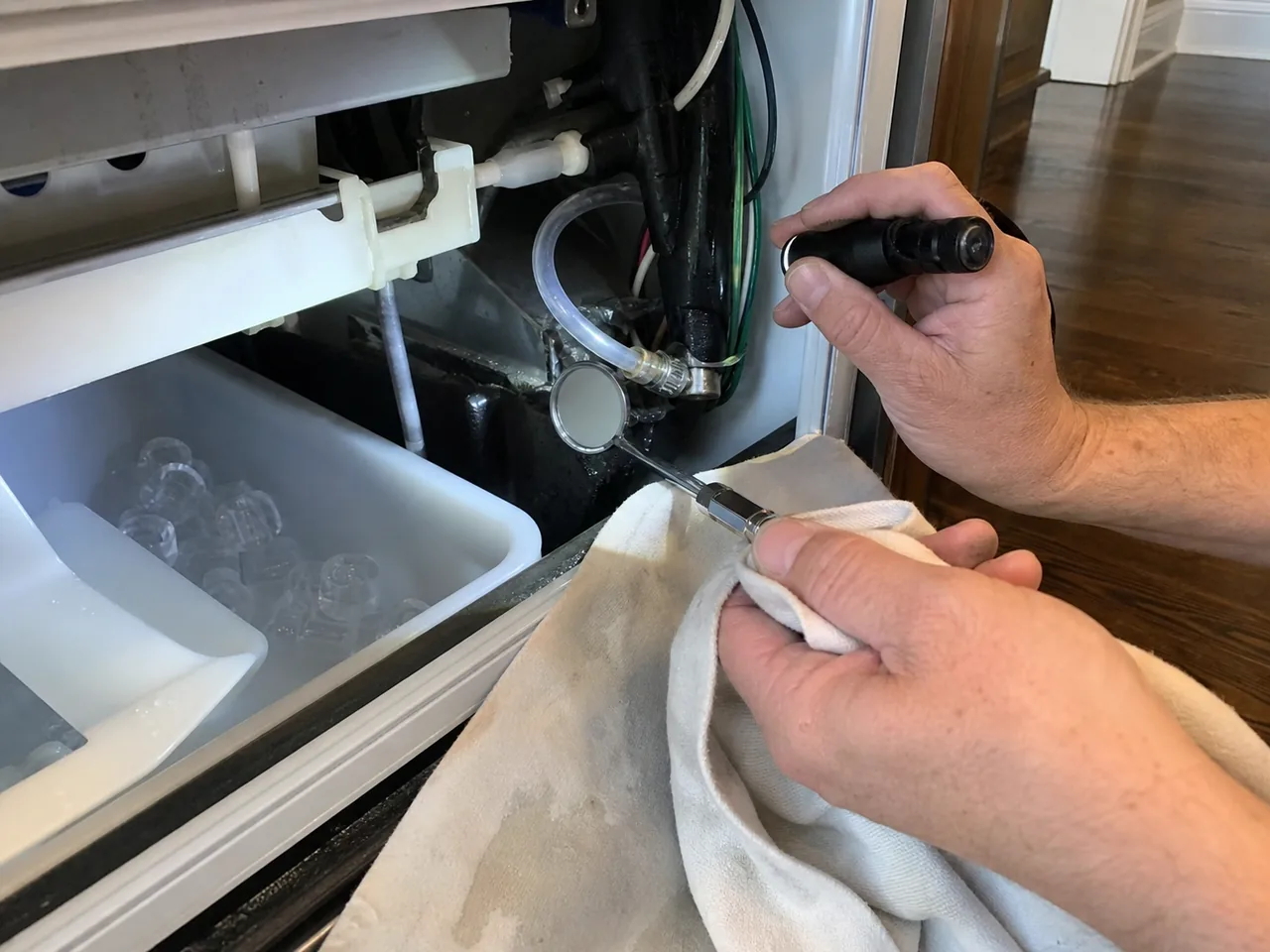
An ice maker is the part of a built-in Sub-Zero that quietly drinks your tap water every day, which makes it the part most shaped by what comes out of the tap. In Danville that water comes from EBMUD, and over years its mineral content leaves a film on every surface it touches inside the machine — the fill valve, the supply line, the filter head and the mold where cubes form.
This is not a temperature problem or a sealed-system fault; it is a water-quality story. Understanding it is the difference between an ice maker that runs cleanly for fifteen years and one that needs a valve every few seasons. Here is how the local water actually affects the machine, and the small routine that keeps scale from turning into a repair.
How hard is Danville's water, really?
EBMUD's primary supply is Sierra snowmelt from the Mokelumne River, which is comparatively gentle as municipal water goes — but "gentle" is not the same as scale-free, and hardness in the East Bay varies by pressure zone, by season, and when the district blends in other sources. The honest answer for any given Danville address is to read your EBMUD annual water-quality report for your zone rather than trust a single number.
What matters for an appliance is cumulative, not dramatic. Even moderate mineral content, run through a fill valve thousands of times a year, leaves a hardening deposit. That is why the wear we see is slow and predictable: it is not that Danville water is extreme, it is that an ice maker is exposed to it constantly, all day, for years.
Where scale attacks the ice maker
The first casualty is usually the water fill valve at the back of the cabinet. Mineral deposits build on its small seat and screen until the valve no longer closes fully — so it weeps a slow drip — or no longer opens fully, so the mold underfills and you get small, hollow or misshapen cubes. A valve that has scaled this way is also the source of many of the rear-corner floor leaks we trace in older built-ins.
From there scale works along the supply line and into the filter head, where it can restrict flow and shorten the useful life of each cartridge. Inside the unit it shows up as cloudy cubes, ice that tastes faintly mineral or stale, and a harvest cycle that slows down. None of these are sudden failures; they are the visible stages of the same deposit accumulating where water sits and moves.
A maintenance cadence that actually works here
Because the wear is cumulative, the fix is a rhythm rather than a single action. Change the water filter on schedule — roughly every six months for most households, sooner if your ice volume is high or you notice flow dropping — and date the cartridge so you are not guessing. When you swap it, seat the new one square and check the head fittings for a wet trail or white crust, the early sign a connection is starting to seep.
Twice a year, glance at the cube quality: shrinking, cloudy or slow-forming ice is your early-warning system that the fill valve or line is scaling before it fails outright. If your household leans hard on ice — and Danville's hot, dry summers mean most do — treat the higher end of the filter cadence as the rule, not the exception. This routine costs a filter and a few minutes; the alternative is a valve and a service call.
When scale has crossed into a repair
Maintenance handles the deposit; it does not reverse a valve that has already scaled shut or a fitting that has started to leak. Once the fill valve weeps steadily, the cubes stay small no matter how fresh the filter is, or you find water pooling at a rear corner, the machine needs hands on it rather than another cartridge.
At that point the repair is bounded and worth doing: a fill valve, a line, or a filter head are well-stocked parts on a unit built to last. If you have reached that stage, our diagnostic-vs-repair pages explain how the $89 visit applies toward the work, and the related pages below cover the water-line service itself and what to do when a built-in is already leaking on the floor.
· FAQ
Questions & answers
Is Danville's EBMUD water hard enough to damage a Sub-Zero ice maker?
EBMUD's Mokelumne supply is moderate rather than extreme, but an ice maker runs that water through a small valve thousands of times a year, so even moderate hardness leaves a cumulative deposit. Over years that scale is enough to wear a fill valve and dull cube quality. Check your zone's EBMUD water-quality report for your specific hardness.
How often should I change my Sub-Zero water filter in Danville?
About every six months for most households, sooner if you make a lot of ice or notice flow slowing. Date the cartridge when you install it, and check the filter-head fittings for white crust or a wet trail each time — that is the earliest sign scale is starting to seep at a connection.
My ice cubes are small and cloudy — is that the water or the machine?
Usually both working together: mineral scale on the fill valve or line restricts the water reaching the mold, so cubes underfill and look cloudy. A fresh filter sometimes helps, but if small or hollow cubes persist the valve has likely scaled and needs replacing rather than another cartridge.
Go deeper
More Danville guides
Why Does My Freezer Keep Icing Up at the Bottom? How the Drain, Seal and Defrost Cycle Work
Ice on the freezer floor means meltwater or humid air is getting in. The 3 usual causes in a Sub-Zero freezer, safe owner checks and when to call a technician.
Read the guide → Noise guide · 7 minFridge Freezer Making Noise? Which Sounds Are Normal and Which Mean a Fault
Fridge freezer making noise? Learn which hums, clicks and pops are normal on a Sub-Zero built-in and which grinding, buzzing or clicking sounds mean a fault.
Read the guide → Choosing a repair service · 7 minHow to Choose a Sub-Zero Repair Service in Danville and Blackhawk
Vetting a Sub-Zero repair company in Danville: gate clearance for Blackhawk, hillside and panel-ready access, and whether one company can cover the Wolf too.
Read the guide →Rather leave it to a specialist?
Have the failing compartment and model number ready, and you will get a real first opinion — not a sales pitch.